Cybersecurity is no longer just an enterprise concern. Small and mid-sized businesses in Chicago — law firms in Evanston, logistics companies in Schaumburg, accounting practices in Naperville, construction firms in Aurora — are actively targeted by ransomware gangs, phishing campaigns, and business email compromise attacks every day. The question isn’t whether your business is a target. It’s whether your IT partner is giving you the protection you actually need.
Why Chicago Small Businesses Are a Target
Attackers use automated tools to scan the internet for vulnerable systems at scale — they don’t hand-select large companies, they hit thousands of small businesses simultaneously because smaller organizations typically have weaker defenses. The average cost of a ransomware attack for a small business now exceeds $200,000 when you factor in downtime, recovery costs, lost productivity, and client churn. Most small businesses that suffer a significant breach don’t fully recover.
What Your IT Partner Should Cover
A modern cybersecurity stack isn’t a single product — it’s a layered set of controls working together. Not every business needs every layer at the same level, so a good provider builds the stack around your risk and budget rather than selling one fixed bundle, and tells you plainly what’s included and what’s optional:
- Endpoint Detection and Response (EDR) — continuously monitors device behavior and responds automatically to suspicious activity, isolating an affected device before ransomware spreads.
- Application allowlisting — only permits approved, known-good software to run. Ransomware and unauthorized tools are blocked by default, not because they’re detected as malicious, but because they were never approved to begin with.
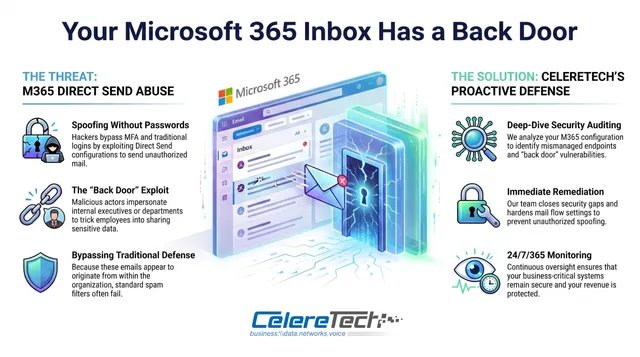
- Multi-factor authentication — blocks the vast majority of credential-based attacks. Every user should have MFA enforced, especially on Microsoft 365 and remote access tools.
- Email security and phishing protection — email is the primary attack vector for most small business breaches; advanced filtering should catch phishing, malicious attachments, and impersonation before they reach an inbox.
- Zero Trust network access — no user, device, or application is trusted by default, even inside your own network. Especially important with remote workers, multiple locations, or third-party vendors.
- Patch management — most successful attacks exploit known vulnerabilities in unpatched software. Patching should run on a regular, documented schedule, not wait for a request.
- Business continuity and disaster recovery — tested, immutable backups and a documented recovery plan for when (not if) an incident occurs.
How Much Does Cybersecurity Cost for a Small Business in Chicago?
Pricing varies significantly by provider and how many layers of protection you’re buying, so treat any generic industry number with skepticism. What actually determines the bill is how much of the stack, EDR, MFA enforcement, email filtering, monitoring, is included versus billed as separate line items.
The real cost question isn’t the monthly rate on its own, it’s what’s actually included in it. Two quotes that look different on the surface often aren’t comparing the same coverage: one may include threat detection or application allowlisting in the base rate, another may list them as add-ons, and a third may leave them out entirely. Ask for a full, written breakdown of what’s included and what’s optional before comparing two providers on price alone, or get a quote from CelereTech and we’ll show you exactly what’s covered.
Cybersecurity by Industry
- Legal firms — attorney-client privilege creates strict confidentiality obligations; encryption, secure file sharing, and access controls are non-negotiable.
- Financial services and wealth management — client financial data is among the most valuable data an attacker can obtain, and compliance requirements make cybersecurity business-critical.
- Accounting firms — tax data and financial records are high-value targets, and tax-season deadline pressure makes staff more susceptible to phishing.
- Logistics and transportation — ransomware-driven supply chain disruptions cascade to customers and partners; operational technology and fleet systems need specific security consideration.
- Construction and contracting — bid data, contract terms, and project financials are valuable and often under-protected, with remote job-site work adding attack surface.
Red Flags When Evaluating an IT Partner
- No written, itemized breakdown of which security controls are included and which cost extra
- Reliance on antivirus alone, with no mention of EDR, allowlisting, or Zero Trust
- No MFA enforcement across the organization
- No written, specific list of the security controls they manage
- Backups that have never actually been tested with a real restore
How CelereTech Protects Chicago-Area Small Businesses
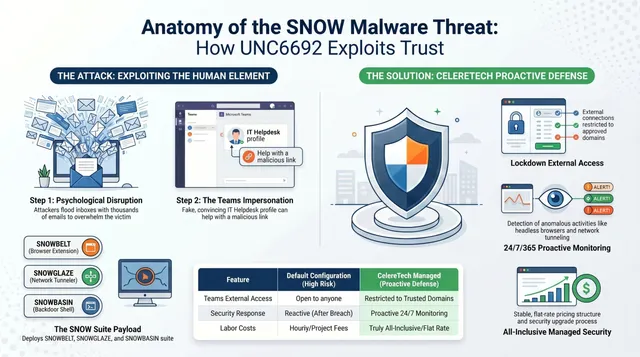
CelereTech builds a layered cybersecurity program on top of every managed IT plan. Core endpoint management, including monitoring, antivirus, monthly patching, encryption, and remote lock and wipe, comes standard. From there we add the layers your business needs, such as Advanced Endpoint Protection with a team responding 24x7, application allowlisting, MFA enforcement, Microsoft 365 security hardening, email threat filtering, Zero Trust network access, and immutable backup with tested disaster recovery, all quoted together on one monthly invoice. Building it this way means every client gets exactly the protection their business needs for its budget, without paying for layers that don’t fit, and without gaps nobody mentioned.
Call (847) 658-4800, get a free quote, or schedule your free security assessment online to discuss pricing for your business.
Also see: Cybersecurity Services, Managed IT Services — serving Schaumburg, Skokie, Oak Brook, and all Chicagoland locations.