Most of the marketing around AI voice agents focuses on what they can do — answer calls, book appointments, capture leads. The more useful question for a business actually evaluating one is the opposite: what happens on the calls it can’t handle? That’s where a real difference shows up between a genuinely useful deployment and a frustrating one.
Escalation Is the Feature That Actually Matters
Orbit AI operates inside guardrails defined during setup and escalates to a person whenever a request falls outside what it’s configured to handle. It doesn’t guess on sensitive topics, and it doesn’t try to force an answer it isn’t confident about. The design principle is straightforward: handle what’s genuinely routine, and hand off cleanly the moment something isn’t. See our Orbit AI FAQ for more on how that scope gets defined for a specific business.
Confidence Thresholds Are Configurable, Not Fixed
How cautious Orbit AI is before escalating is something CelereTech configures to your business, not a setting baked in at the platform level. A professional services firm handling sensitive client matters might want a tight, quick-to-escalate configuration; a retail line fielding order-status questions might reasonably let Orbit AI handle a broader range of requests directly. Neither is a “default” — both are configuration choices made during setup.
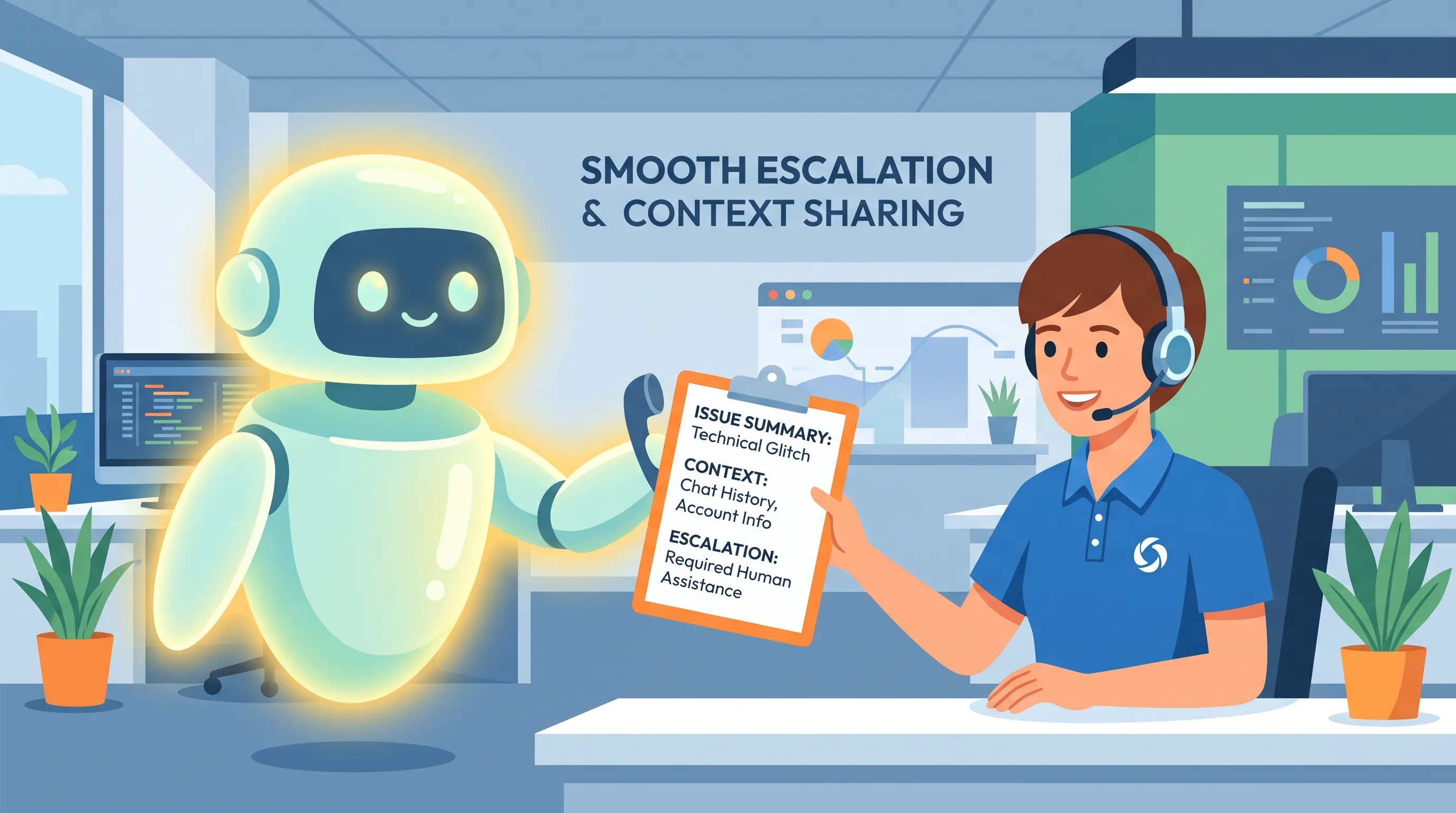
A Handoff With Context Beats a Cold Transfer
One detail that’s easy to overlook: every call Orbit AI handles produces a transcript and summary. When a call escalates to a person, that person has a record of what’s already been discussed, rather than the caller having to repeat themselves from scratch to whoever picks up. That’s a meaningfully better experience than the classic cold-transfer problem most businesses have already run into with a traditional phone tree or answering service.
What This Looks Like Alongside Your Existing Phone System
Escalation only works well if it’s actually wired into the routing you already have — hunt groups, time-of-day rules, direct extensions. Orbit AI doesn’t replace that routing; it sits in front of it, handling what’s in scope and passing everything else through the paths you’ve already built. Our guide on how Orbit AI works with your business phone system covers this in more depth, including where emergency and E911 calls stay firmly on the human path regardless of anything else Orbit AI is configured to handle.
Why “Answers Everything Confidently” Is the Wrong Goal
It’s worth being explicit about a design trade-off that isn’t obvious from a feature list: an AI system tuned to always produce a confident-sounding answer, even to requests it’s genuinely unsure about, is worse than one tuned to escalate more often. The failure mode of over-confidence is a caller getting an answer that’s wrong, incomplete, or inappropriate for their situation — and not knowing it, because the system delivered it the same way it delivers a correct answer. The failure mode of appropriate escalation is, at worst, a call taking one extra step to reach a person. Those aren’t equivalent risks, which is why Orbit AI’s design leans toward escalating when a request carries ambiguity rather than forcing a resolution.
This is also where the comparison to a traditional rules-based chatbot breaks down in Orbit AI’s favor. A scripted system either matches a pattern or it doesn’t — when it doesn’t, it typically loops the caller or produces an obviously wrong response, because it has no real way to recognize its own uncertainty. Orbit AI’s underlying reasoning is closer to genuine language understanding than pattern matching, which is precisely what makes a deliberate, configured escalation threshold possible instead of a hard failure. See Orbit AI vs. Traditional Chatbots for more on that distinction.
What Escalation Configuration Actually Looks Like in Practice
During setup, CelereTech works through the specific call types a business actually receives and sorts them into three buckets: requests Orbit AI handles directly with high confidence (appointment scheduling, store hours, order status), requests that get a conservative default toward escalation (anything touching sensitive personal information, unusual or compound requests), and requests that always route to a person regardless of context (anything resembling an emergency, or a topic explicitly carved out of scope). That sorting isn’t guesswork — it’s built from the same call patterns a business already has visibility into from its existing phone system, refined after the first weeks of real call volume once actual patterns are visible rather than assumed in advance.
The Deployment Timeline Question
A fair skepticism about any new phone system technology is whether “rapid deployment” is real or a sales phrase. In this case it’s concrete: businesses typically go live in days, not months, using pre-built calendar connectors rather than a custom integration project, with CelereTech’s team handling implementation directly. A pilot on a single call flow — after-hours calls, or one specific line — is also a normal, low-commitment way to see how it actually performs on real calls before deciding how far to expand it.
Escalation Isn’t a One-Time Setting
A detail worth being clear about: escalation configuration isn’t something set once at deployment and left alone. As real call patterns emerge — a new type of request starts showing up, a seasonal shift changes what “routine” looks like for a few weeks — the thresholds that made sense on day one may need adjusting. CelereTech reviews call transcripts as part of an ongoing relationship rather than a one-time implementation, which means escalation rules can tighten or loosen as your business’s actual call volume gives us more to work with than assumptions made before go-live.
How CelereTech Approaches Escalation Design
CelereTech configures Orbit AI’s scope and confidence thresholds specifically for your business before it takes a single real call, and we treat escalation design as the most important part of the setup — not an edge case to handle later. A voice agent that answers everything confidently, including the things it shouldn’t be confident about, isn’t actually the safer choice; the one that knows what it doesn’t know is.
Request a demo of Orbit AI before deciding whether it fits how your calls actually get handled today.