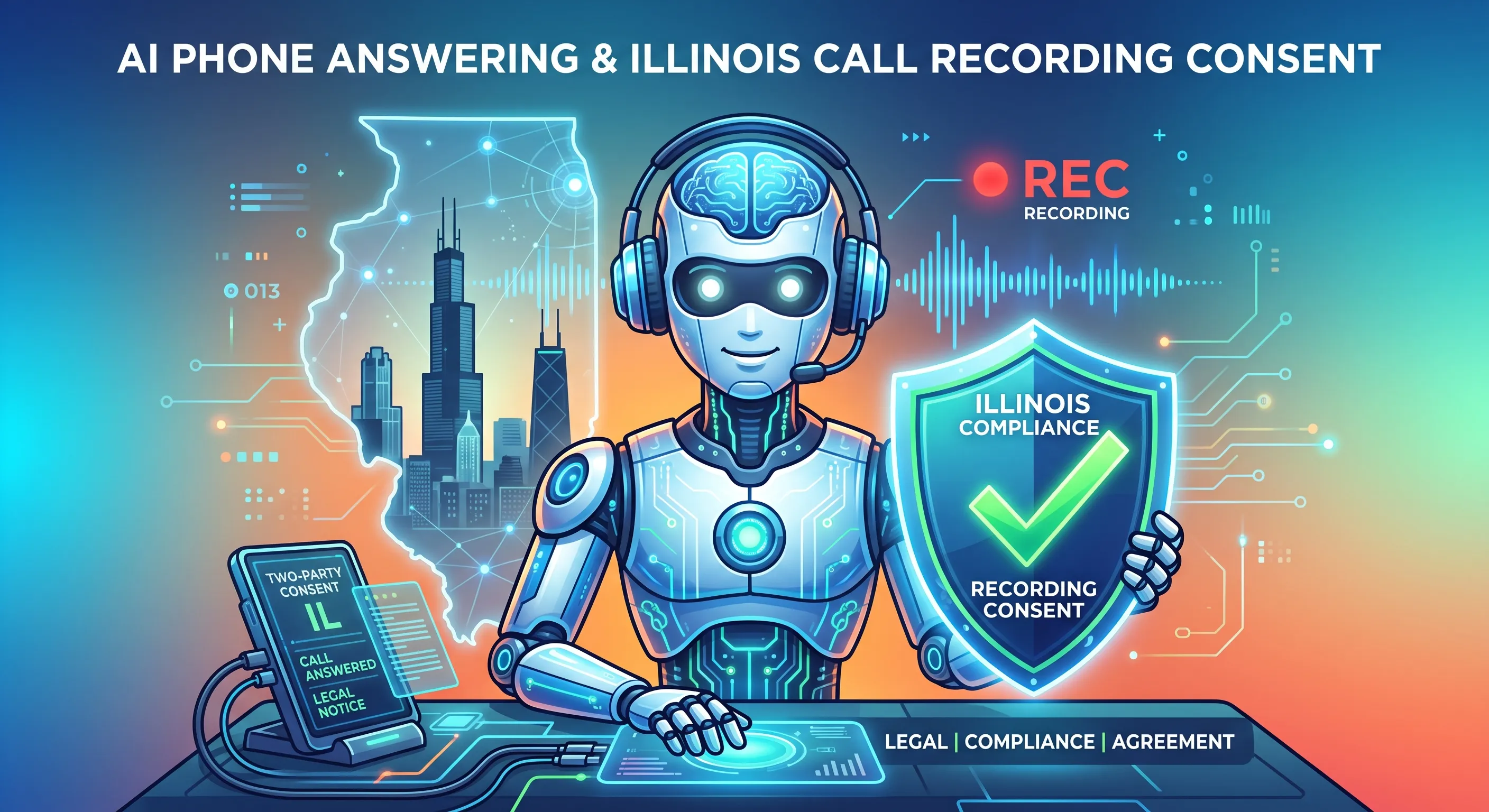
Businesses considering an AI voice agent for their phones in Illinois often ask a version of the same question: does anything change legally when the entity answering — and recording — the call is an AI instead of a person? Our Illinois call recording consent guide already covers the state’s all-party consent requirement in depth; here’s how that requirement applies to an AI-answered call specifically, and what’s a separate, non-legal question worth thinking through anyway.
The Recording-Consent Law Doesn’t Care Who’s Recording
Illinois’ eavesdropping statute, 720 ILCS 5/14-2, requires all-party consent before a private conversation is recorded. The requirement is about the act of recording and whether every participant consented to it — not about who or what technically initiates that recording. An AI voice agent recording a call carries exactly the same consent obligation a human-answered, human-recorded call would carry. Nothing about the underlying law shifts based on the technology doing the answering.
The Same Disclosure Mechanism Still Works
The standard way businesses satisfy Illinois’ consent requirement — an automated message at the start of a call along the lines of “this call may be recorded for quality and training purposes” — works exactly the same way on an AI-answered line. Continuing the conversation after that disclosure generally constitutes implied consent, regardless of whether a person or Orbit AI is doing the answering afterward. If anything, an AI voice agent makes this more consistent to maintain: it plays the disclosure on every call without the risk of a busy staff member forgetting, the same reliability benefit an automated IVR consent message already provides on a human-staffed line.
A Separate Question: Should Callers Know They’re Talking to an AI?
This is worth distinguishing clearly, because it’s easy to conflate with the recording-consent question and it isn’t the same thing. Illinois’ eavesdropping statute addresses consent to be recorded — it doesn’t separately mandate that a caller be told they’re speaking with an AI rather than a person. Whether to identify Orbit AI as an AI during a call is a transparency and brand decision, not a compliance requirement we’re asserting exists under Illinois law. CelereTech configures this based on what a business actually wants — some businesses want Orbit AI to identify itself plainly, others configure a persona that simply focuses on resolving the caller’s request quickly. Either choice is a business decision, not a legal one, at least as it concerns the specific statute this guide covers.
What Happens to the Transcript
Orbit AI produces a post-call transcript and summary of every call it handles. That transcript is a derivative of the recording itself — if the underlying call was recorded with proper Illinois-compliant consent, the transcript generated from it doesn’t introduce a separate compliance question. It’s the same record, in a more useful, searchable form.
The Voice Biometrics Wrinkle Still Applies
Our full consent guide covers one additional consideration worth restating in the AI context: if call recordings are analyzed for voice biometric identification purposes, Illinois’ Biometric Information Privacy Act layers its own requirements on top of the eavesdropping statute’s consent obligation. That’s a specific, narrow scenario — biometric identification, not general natural-language processing used to understand what a caller is asking for — but it’s worth flagging because “AI processes the audio” and “AI performs biometric voice identification” aren’t the same thing, and a business evaluating any voice AI vendor should understand which category a given feature actually falls into before assuming BIPA is or isn’t relevant.
Why This Matters More, Not Less, With Higher Call Volume
One practical reason to think through consent configuration carefully before adopting an AI voice agent: if Orbit AI is handling a meaningfully higher volume of calls than your team was answering manually, any gap in the consent disclosure gets multiplied across that volume rather than depending on one employee’s habits on a given day. A misconfigured or missing disclosure on a human-staffed line might affect a handful of calls before someone notices; the same gap on a high-volume automated line compounds faster. That’s an argument for getting the disclosure configuration right at setup, not a reason to avoid automating call answering — the fix is the same automated, consistently-applied disclosure this guide already recommends, just verified as part of onboarding rather than assumed.
The Multi-State Business Answer Doesn’t Change Either
For businesses fielding calls from outside Illinois, the same guidance that applies to human-answered lines applies here: Illinois’ law reaches interstate calls where one party is in Illinois, so the simplest, most defensible approach is a consistent automated disclosure applied to every call regardless of the caller’s location — one policy, not a jurisdiction lookup on every incoming number.
What This Means for Businesses Outside Illinois Too
CelereTech serves Chicagoland businesses first, but many of them take calls from customers, vendors, and partners well outside Illinois — and the guidance here doesn’t require sorting calls by where they originate. Because Illinois’ law reaches any call where one party is in Illinois, and because a consistent policy is simpler to maintain than a jurisdiction-by-jurisdiction one, the same automated disclosure configuration that satisfies Illinois’ requirement also covers the business in every other state it operates in, without needing a separate consent framework per state.
How CelereTech Approaches This
CelereTech configures Orbit AI’s consent disclosure the same way we configure it for any hosted VoIP line — playing automatically, consistently, before a call is recorded, regardless of call volume or time of day. If you’re evaluating Orbit AI specifically for how it handles calls under Illinois’ consent requirements, that configuration is part of the standard setup, not an add-on. We also document the recording policy itself as part of onboarding, so the compliance posture doesn’t depend on institutional memory of how the system was originally configured, and it holds up the same way whether the person reviewing it a year from now was involved in the original setup or not.
Request a demo of Orbit AI to see how consent disclosure is configured for your business.