
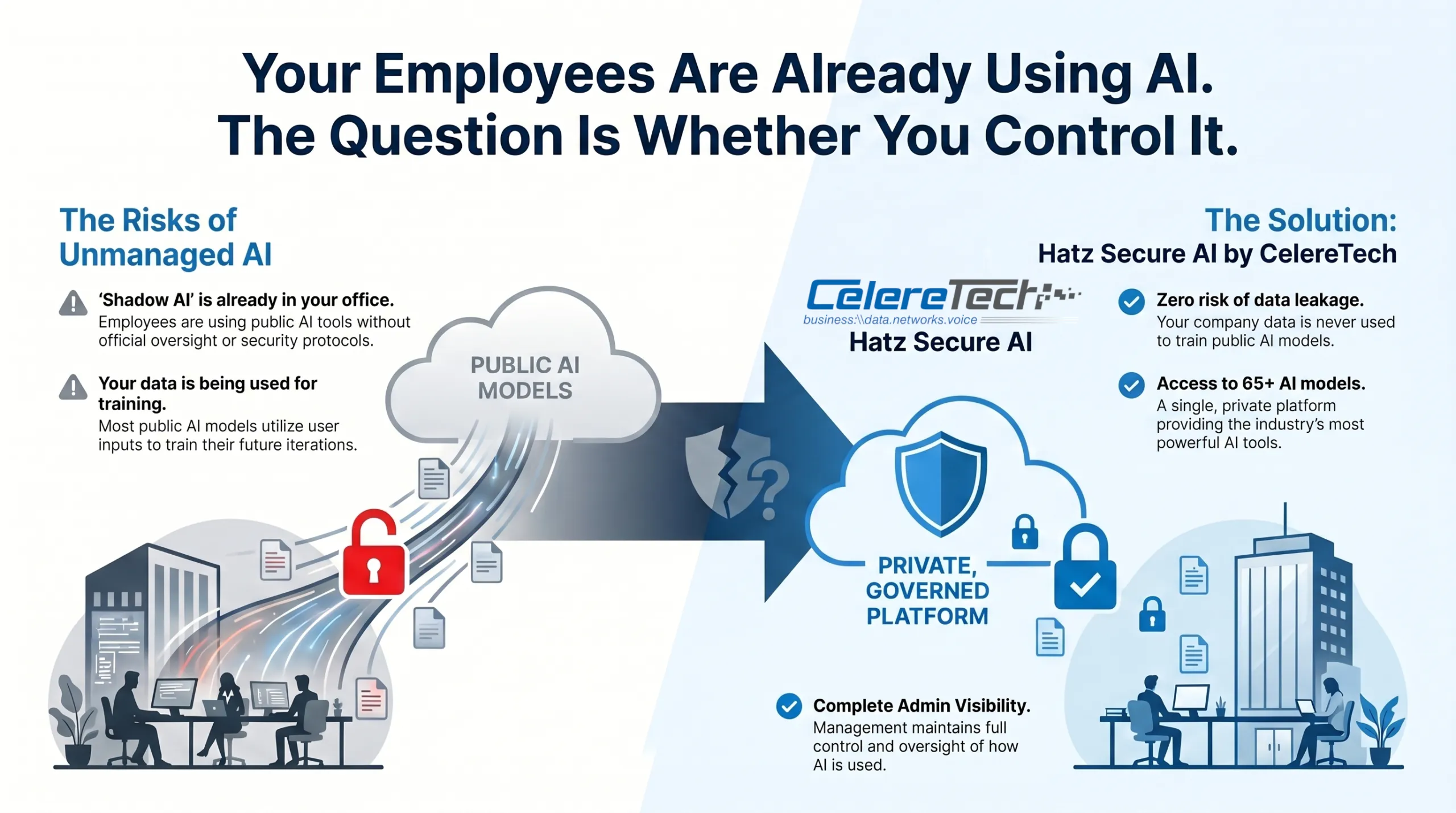
Artificial intelligence has crossed a threshold. It’s no longer a tool only large enterprises with dedicated AI teams can access — it’s sitting on every employee’s phone, in their browser, and increasingly embedded in the apps your business already uses every day.
The question is no longer whether your employees are using AI. The question is whether you know about it, control it, or are exposed by it.
The Shadow AI Problem
Most business owners assume that because they haven’t formally rolled out an AI tool, AI isn’t being used inside their organization. That assumption is almost always wrong. Recent industry surveys found that 98% of organizations have employees using unsanctioned AI tools, and roughly two-thirds of office workers admit to using AI at work even when they believe it isn’t officially permitted.
Employees are resourceful. When they discover that AI can help them draft a proposal in minutes, summarize a 40-page contract, or respond to a client email faster, they use it — with or without IT approval. They paste client information into ChatGPT. They upload internal documents to public AI tools to get a quick summary. They use personal Copilot accounts tied to personal Microsoft logins.
This phenomenon is called Shadow AI, and it carries real risks:
- Data privacy exposure — When an employee pastes confidential client data, financial records, or proprietary business information into a public AI tool, there’s often no guarantee that data won’t be used to improve the model or stored on third-party servers outside your control.
- Compliance risk — For businesses in regulated industries — legal, financial, healthcare — uncontrolled AI use can create serious compliance violations, even if unintentional.
- No audit trail — If something goes wrong, you have no record of what was shared, when, or by whom.
- Inconsistent outputs — With no standardized tools or policies, different employees get wildly different results, making AI more of a wildcard than an asset.
Banning AI outright isn’t a realistic solution — the productivity benefits are too significant, and enforcement is nearly impossible. Industry research backs this up directly: offering employees a capable, sanctioned AI tool cuts unauthorized usage by as much as 89% compared to a policy-only approach. The only viable path forward is to implement AI on your terms, with control and governance built in from day one, whether that’s Microsoft 365 Copilot for teams already standardized on Microsoft 365, or a dedicated platform like Hatz for broader model access.
The Risks of Getting It Wrong
1. Your confidential data may be training public AI models
Many popular consumer AI tools explicitly state in their terms of service that user inputs can be used to improve their models. When an employee pastes a client contract, an internal financial report, or sensitive HR information into one of these tools, that data may not stay private. For a law firm, a financial services company, or any business handling sensitive client information, this isn’t a theoretical risk — it’s a real and immediate one.
2. You’re locked into a single vendor
Organizations that default to one public AI tool — whether ChatGPT, Copilot, or another platform — become dependent on that vendor’s pricing, availability, and capabilities. Different tasks are genuinely better suited to different AI models, and without the ability to compare and choose, you’re leaving performance and cost efficiency on the table.
3. Adoption without accountability
Without organizational oversight, you have no visibility into whether AI is actually being used effectively. Some employees may be heavily dependent on it while others haven’t touched it, with no way to measure ROI, identify training gaps, or ensure consistent usage standards.
4. No governance framework
Effective AI use inside a business requires policies — what tools are approved, what data can be processed, what outputs require human review. Without a managed platform, there’s no enforcement mechanism for any of these policies.
The Solution: Controlled, Organizationally Managed AI
The answer to Shadow AI and uncontrolled AI risk isn’t to prohibit AI — it’s to provide a secure, governed alternative that your team actually wants to use.
That’s where Hatz Secure AI comes in, and it’s what CelereTech deploys and manages for Chicago-area businesses. Hatz is a private, organizationally managed AI platform that gives your entire team access to the power of AI while keeping your data secure, your usage visible, and your organization in control.
A private AI environment — your data never trains the models
Unlike public tools, Hatz operates as a walled garden. Your conversations are kept confidential and are never used to train large language models. Sensitive documents can be processed and analyzed without being stored on third-party servers.
Access to 65+ AI models — not locked into one
Hatz gives your team access to over 65 large language models, including GPT-4o, Claude, Gemini, Llama, and Mistral. Different models excel at different tasks — drafting, analysis, coding, research — and Hatz allows side-by-side model comparison so your team always uses the right tool for the job.
Organization-wide control and admin visibility
Administrators have full visibility into AI usage across the organization — who is using it, how often, and for what types of tasks. Usage analytics help identify adoption gaps, measure ROI, and ensure consistent usage policies are followed.
No-code workflows and automations
Hatz’s no-code workflow builder allows your team to automate multi-step processes in plain language, no developer required — automating email responses, summarizing incoming documents, conducting research, or processing data.
Integrations with the tools you already use
Hatz connects with Microsoft 365, Google Workspace, LinkedIn, and web research tools including Exa, Tavily, Google Search, Firecrawl, and Perplexity. It also generates Word documents, PowerPoint presentations, PDFs, Excel spreadsheets, and images natively.
Open source options for maximum privacy
For organizations with the most stringent data privacy or compliance requirements, Hatz supports open source AI models hosted entirely within Hatz’s own cloud environment — no data leaving to any foundational model provider at all.
Addressing the Common Concerns
“We already use ChatGPT or Copilot.” That’s a great starting point, and it proves the value of AI to your team. The challenge with standalone tools is twofold: your data may be used to train public models, and you’re locked into one provider. Hatz gives your team access to 65+ models in one secure, controlled environment, plus workflows and integrations that turn basic chat into real business automation.
“I’m worried about data security.” That concern is exactly why Hatz was built. Hatz operates as a walled garden: nothing your team uploads is used to train models, nothing goes out to the web uncontrolled, and you have full admin visibility into all activity.
“AI isn’t relevant to our business.” That’s what most businesses say until they see it applied to their specific workflows — research, email drafting, data reconciliation, document review, content creation, client onboarding. Every business has repetitive, time-consuming tasks AI handles in a fraction of the time.
“My team won’t use it.” Low adoption is the number one reason AI investments fail, and it’s a legitimate concern. Hatz addresses this directly with built-in training courses, a crawl-walk-run onboarding framework, and admin tracking so you can see who is engaged and who needs support.
“We don’t have the budget for this right now.” The more useful question is: what is it costing you not to have this? If each employee saves 30-60 minutes per day on tasks AI can handle, the platform pays for itself quickly. Hatz uses a credit-based billing model that scales with usage.
“We don’t have time to implement something new.” CelereTech handles the setup and deployment. Training is self-paced and broken into short segments, and your team starts with one task they already do and sees time savings in their first session.
Why CelereTech Is the Right Partner to Deploy It
CelereTech already manages IT for Chicago-area businesses as a true internal IT department extension — all-inclusive, no surprise invoices, project labor included. Adding Hatz Secure AI to that relationship means you get a managed AI deployment with the same predictable cost model and hands-on support you expect from us. We handle the implementation, the onboarding, the vendor coordination, and the ongoing support.
The Bottom Line
AI isn’t going away. It’s becoming more capable, more embedded in business tools, and more expected by employees. The organizations that will win are the ones that deploy it intentionally — with security, governance, and control — rather than letting it spread unchecked through public consumer tools.
If your organization is ready to implement AI the right way, reach out to CelereTech to schedule a conversation.